The story behind the Watchers and the Nephilim — and how humanity may be fuelling modern UAP activity.
Before I begin, I want to make something very clear: I am a religious person. I believe in God, and I have no wish to challenge His authority or lead anyone away from their faith. If anything, researching and writing this piece has only deepened my connection to Him. We are made in His image, endowed with free will and the gift of intelligence — the ability to ask questions that stretch far beyond ourselves.
The question I explore here is whether those once described in scripture as “gods” or “sons of God” could, in fact, have been visitors from elsewhere in the cosmos — and whether humanity is a reflection of them, here to experience physical existence and to cultivate the immortal, non-physical part of ourselves, just as they did.
My curiosity was rekindled while watching Tucker Carlson discuss UAP phenomena on The Shawn Ryan Podcast in 2024. Carlson spoke hesitantly, saying, “I think I know what it is… you know, I think it’s a really old story.” He eventually linked his thoughts to Genesis 6, referencing insights from people “in the know,” likely within government circles — perhaps deeply religious figures in what was once the Department of Defense and is now referred to as the Department of War.
I’ve studied the Phenomenon for years, but my recent research led me somewhere unexpected: into the thousands of intricate illustrations left behind by Emily Trim. Many within the UAP community will recognize her name. For those who don’t — Emily was one of the children who witnessed the 1994 Ariel School UFO encounter in Zimbabwe, where dozens of students reported seeing a landed craft and two non-human intelligences (NHI).
The children described these beings as telepathic — or perhaps psionic — and possibly capable of manipulating local time perception. Emily possessed extraordinary artistic talent, and after her untimely death last year, she left behind not only vivid memories but also a remarkable body of artwork shared online over the years.
I believe Emily maintained an ongoing connection with whatever entity she encountered as a child. She seemed to serve as a visual medium, producing what she called “automatic illustrations” — art created as if guided by an unseen hand. Her work is profoundly relevant to what follows, and throughout this article, I reference elements from her drawings to illustrate parallels between ancient scripture and modern experiences.
The Book of Genesis
To explore the roots of this story, we start at the beginning — with Genesis, the book that records the dawn of humanity. One detail had long escaped my attention: the extraordinary lifespans of the earliest humans.
Adam reportedly lived for 930 years. That sounds like myth — until we consider the possibility of an advanced species capable of genetic engineering, time manipulation, or even cryogenic preservation. The generations that followed lived similarly long lives, though their years gradually decreased.
Then, in Genesis 6:3, we encounter a pivotal passage:
“My Spirit shall not abide in mortals forever, for they are flesh; their days shall be one hundred and twenty years.”
This verse, I believe, holds a profound clue. It echoes the mystery of the Holy Trinity — the Father, the Son, and the Holy Spirit — and suggests that humanity embodies all three aspects simultaneously. Through what might be called a form of divine quantum entanglement, we are part of God’s consciousness (the Father), incarnate in physical form (the Son), and animated by unseen spiritual energy (the Holy Spirit).
In Genesis 6:3, it seems the Creator determined that 930 years was too long for the purpose of mortal existence. The lifespan limit was reduced to 120 years — not abruptly, but over generations.
I found it fascinating that hundreds of years after the decree in Genesis 6:3, Moses became the first human in canonized scripture to live exactly one hundred and twenty years — the precise lifespan God had set for mortals. This seems far more than coincidence. As one of the most pivotal figures in the biblical narrative, Moses’ life embodies the completion of that divine adjustment first announced before the Flood. His perfect alignment with the limit declared centuries earlier suggests that the Creator’s intention had finally taken full effect, that the long “reset” of humanity was complete.
Symbolically, Moses stands as the first fully realized human of the post-Genesis era — a being living wholly within the bounds of divine law, yet still radiant with spiritual vitality. Even at the end, scripture tells us, “his eye was not dim, nor his vigor abated” (Deuteronomy 34:7), implying that though his mortal years had reached their ordained measure, his spirit remained unbroken — the mark of a soul perfectly balanced between the physical and the divine.
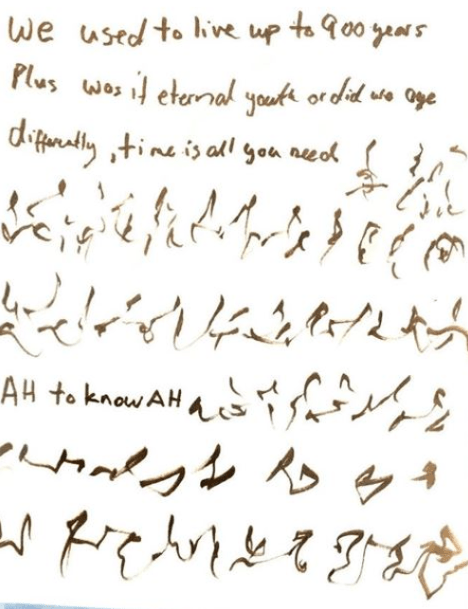
Emily Trim Automatic Writing Illustration possible referencing communication with a divine entity capable of mortal life up to 900 years, coincidentally or otherwise matching that of those early humans.
The Nephilim
In Genesis 6:4, we find one of the most intriguing and controversial passages in all of scripture:
“The Nephilim were on the earth in those days—and also afterward—when the sons of God went into the daughters of humans, who bore children to them. These were the heroes of old, warriors of renown.”
The verse mentions the Nephilim only briefly, yet it hints at something profound — a hybrid race born from the union of the “sons of God” and human women. Importantly, the tone is not one of condemnation but of acknowledgment, suggesting a time when divine and mortal realms were less distinct.
Later, in the Book of Enoch, these “sons of God” are identified as The Watchers — angelic beings sent to observe humanity. Genesis 6:5 continues the story, describing God’s grief at humanity’s corruption:
“The wickedness of humankind was great in the earth, and every inclination of the thoughts of their hearts was only evil continually.”
Yet notably, God’s anger here is directed not at the Nephilim but at humankind. He regrets creating them and declares His intent to reset creation.
The Colonization Hypothesis
Let us pause here and consider this narrative through the lens of a speculative idea — one that imagines the events of Genesis and Enoch not as myth, but as a documented primitive human memory of contact with an advanced civilization.
Imagine you are part of a spacefaring species — non-biological or semi-biological beings arriving in a young solar system to seed and cultivate life. You create a primitive reflection of yourselves, perhaps to experience physical existence, perhaps to study it. You send a group of scientists down to a fertile planet, bound by strict instruction: observe, but do not interfere.
Inevitably, the rule is broken.
Orders are disobeyed, protocols ignored, and your genetic experiment begins to spiral out of control. Containment fails. The logical solution? A planetary reset — not by total destruction, but by flooding the surface to cleanse and restart the biosphere while preserving the planet itself.
Before initiating the reset, your team would preserve the genetic codes of every living organism, ensuring that life could later be reseeded once conditions stabilized. Yet, in the biblical narrative, we see something different — a human remnant physically spared: Noah and his family.
Why them, and not the biblical impractical version with representatives of every living species? In this conceptual framework, the answer may lie in function, not favoritism. Humans were the only beings capable of witnessing, recording, and transmitting the memory of the event. Their survival served not merely biological continuity but informational continuity — a safeguard that the history of the reset, and the moral lesson it embodied, would not be lost. From this perspective, the story of Noah’s Flood reflects not divine wrath, but a controlled environmental reset conducted after a failed phase of colonization — one designed to preserve not just life, but awareness.
The Return of the Nephilim
Logically, such a cataclysm should have eradicated the Nephilim. Yet, centuries later in Numbers 13, when Moses sends spies into Canaan, they report:
“We saw the Nephilim there (the descendants of Anak come from the Nephilim). We seemed like grasshoppers in our own eyes, and we looked the same to them.”
This passage rekindles the mystery. How could they have survived? In Hebrew, Nephilim roughly translates as “the fallen ones.” When the Hebrew Bible was translated into Greek (the Septuagint, 3rd century BCE), the term became gigantes — evoking beings of great size and strength. That translation subtly altered meaning, leading later readers to interpret the Nephilim as literal giants.
But the Hebrew sense of “fallen ones” may originally have referred not to physical stature, but to their divine descent — offspring of heavenly beings and humans, possessing extraordinary attributes.
By the time of Moses, “Nephilim” might have become a mythic label, used for powerful warrior tribes whose physical dominance inspired fear — echoes of an ancient legend remembered in distorted form.
Deuteronomy 9:2 continues this theme:
“A strong and tall people, the descendants of the Anakim (who themselves came from the Nephilim). You have heard it said: ‘Who can stand up to the Anakim?’
Know then today that the Lord your God is the one who crosses over before you as a devouring fire; He will defeat and subdue them before you.”
By this point, Nephilim no longer denotes supernatural hybrids, but a cultural metaphor for formidable enemies. The ancient writers used the term as symbolic shorthand — a reminder of chaos and rebellion subdued by divine will. The focus shifted from biology to theology: no matter how “giant” the foe, God’s purpose would prevail.
The Hidden History in the Dead Sea Scrolls
Still, I wondered: why do the Nephilim bear such a dark reputation? Searching for answers led me to the Dead Sea Scrolls, discovered between 1947 and 1956 near Qumran. These ancient manuscripts, written in Hebrew, Aramaic, and Greek, include fragments of nearly every book of the Hebrew Bible — along with hymns, laws, apocalyptic visions, and sectarian writings.
Among these texts are fragments that expand upon Genesis 6, particularly the Book of Giants and portions of Enoch. These writings describe in vivid detail the union of the Watchers and human women, and the birth of their hybrid offspring.
The Book of Enoch, though excluded from the official Hebrew and Christian canons, held deep influence in early theology. The Epistle of Jude (1:14–15) even quotes it directly, showing that early Christians regarded it as spiritually authoritative.
Enoch’s account provides an insider’s view of divine judgment — a chronicle of rebellion, corruption, and cosmic justice. It bridges the gap between Genesis and the mythic memory of the Nephilim, transforming scattered verses into a coherent narrative of cause and consequence.
The Book of Enoch – The Watchers
When we move from Genesis to the Book of Enoch and the story deepens, the mysterious “sons of God” become The Watchers — celestial beings sent to observe humanity. Even in their name lies a warning: they were meant to watch, not to touch, teach, or interfere.
In the conceptual framework I proposed earlier — the idea of an advanced civilization overseeing a planetary experiment — the Watchers correspond to a group of field scientists or operatives sent from a larger mission base to monitor early human development. The Book of Enoch even gives us their number and hierarchy:
“Then they all swore together and bound one another with a curse. And they were, all of them, two hundred, who descended in the days of Jared onto the peak of Mount Hermon. And they called the mountain ‘Hermon.’”
— Enoch 6:5
Imagine this moment as a literal descent — two hundred beings landing upon Mount Hermon, a perfect location for observation: a mild climate, fertile valleys, and proximity to both fresh and saltwater. From a colonization perspective, the site would have been strategic — defensible, resource-rich, and high enough to remain isolated from the primitive human populations below.
The Book of Enoch even outlines a command structure: twenty leaders, each in charge of nine subordinates. Their names — Shemihazah, Arteqoph, Ramel, Daniel, Asael, and others — are recorded in the text like a roster of a disciplined scientific corps.
In this speculative reading, those two hundred would have left their orbiting base or “mothership” to begin field operations. Their mission parameters were clear: maintain a sterile corridor between themselves and the species they were cultivating. Observation only. No direct interference.
But the Book of Enoch tells us what went wrong. That sterile boundary — scientific, moral, and spiritual — was broken.
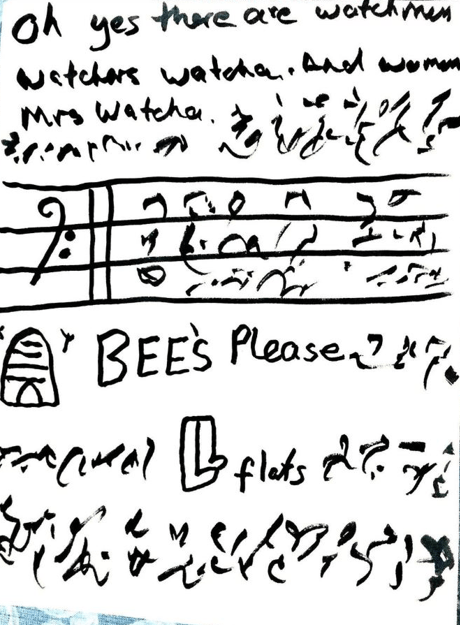
Emily Trim, automatic writing illustration referencing watchers, watchmen and Mrs Watcha, a childhood teacher from Zimbabwe.
The Breach of the Sterile Corridor
Enoch records:
“These and all the others with them took for themselves wives from among them such as they chose.
They began to go in to them, and to defile themselves through them, and to teach them sorcery and charms and the cutting of roots and plants.
And they conceived from them and bore to them great giants. The giants begot the Nephilim, and to the Nephilim were born the Elioud.”
— Enoch 7:1–2
From a theological point of view, this passage describes angels corrupted by desire. From a colonization perspective, it’s a field mission gone catastrophically wrong: unauthorized genetic mixing, unsanctioned knowledge transfer, and the creation of a hybrid species with superior genetic traits.
The consequences were devastating. The Nephilim — these new hybrids — began to dominate and exploit the primitive humans, threatening to erase the purpose of the entire colonization mission.
If containment was no longer possible, there were two options: exterminate the hybrids or attempt a reset. In Enoch, we see both strategies at play.
Recruitment and Propaganda
One subtle possibility is that the mission’s leadership chose to manipulate human populations into turning against the hybrids and indeed turn hybrids against each other — an indirect form of containment. This concept echoes in the scripture, where divine authority motivates mortals to destroy the Nephilim.
Human history provides sobering parallels. Consider Nazi Germany, where the Ministry of Propaganda used myth, fear, and pseudo-science to justify the persecution of an entire people. Narratives can be weaponized, and even moral individuals can be led into atrocity when convinced they are enacting divine or scientific necessity.
This perspective adds nuance to a difficult passage from Enoch:
“They were devouring the labor of all the sons of men, and men were not able to supply them. The giants began to kill men and to devour them. They sinned against birds, beasts, creeping things, and fish; they devoured one another’s flesh and drank the blood.
Then the earth brought accusation against the lawless ones.”
— Enoch 7:6
Whether literal or symbolic, this description mirrors the kind of dehumanizing language used throughout history to justify extermination. Perhaps the hybrids were genuinely destructive — or perhaps they were vilified to rally humanity to a cause they could not fully comprehend.
The line “they sinned against birds, beasts, creeping things, and fish” could signify more than cruelty or slaughter; it might hint at genetic manipulation or experimentation — tampering with creation itself. Some versions of the Dead Sea Scrolls even describe this as bestiality and the breeding of unnatural creatures, emphasizing corruption through forbidden knowledge.
Judgment and Reset
Eventually, the rebellion reaches the highest levels of heaven. Enoch records:
“Michael, Sariel, Raphael, and Gabriel looked down from the sanctuary of heaven and saw the bloodshed on the earth. The earth, devoid of inhabitants, raised its voice to the gates of heaven. The souls of men made suit, saying, ‘Bring our judgment before the Most High, and our destruction before the glory of the majesty of the Lord of lords.’”
In theological language, these are archangels witnessing a fallen world that is appealing to God for justice. In the colonization framework, they are senior officials observing from orbit — alarmed at the chaos below. The “voices of men” rising to heaven might be a poetic rendering of radio transmissions or other forms of contact described in the only language available to ancient human minds.
The situation on Earth has deteriorated beyond recovery. Famine, violence, and cannibalism prevail — a collapse of civilization. To preserve the mission, intervention is ordered:
“Go, Gabriel, to the bastards, to the half-breeds, to the sons of miscegenation; destroy the sons of the Watchers from among the sons of men; send them against one another in a war of destruction. They shall not live long; no petition shall be granted to their fathers on their behalf, nor shall they expect everlasting life—nor even five hundred years.”
In this passage, Gabriel is the operative sent to sow division among the hybrids — to turn them against one another, thereby neutralizing the threat without exposing the full machinery of divine or extraterrestrial authority.
A second directive follows:
“Go, Michael, bind Shemihazah and the others who have mated with the daughters of men and defiled themselves. When their sons perish, and they see the destruction of those they love, bind them for seventy generations in the valleys of the earth, until the day of their judgment and consummation. Then they will be led to the fiery abyss and imprisoned forever. Destroy the spirits of the half-breeds and the sons of the Watchers, for they have wronged mankind.”
This is both cosmic justice and political messaging. The rebels are not executed swiftly but forced to witness their offspring’s destruction — a punishment designed to deter future defiance. In the colonization model, it demonstrates to other operatives that rebellion carries the ultimate price.
In the Dead Sea Scrolls, this punishment is elaborated upon: the Watchers’ spirits were not destroyed but bound to the Earth, denied ascension. Their offspring were disembodied yet conscious, they were trapped on the earth without mortal flesh — what later traditions would call demons.
From a scientific-mythic viewpoint, this implies a technology capable of isolating or containing the non-physical essence of our existence — a terrifying notion of spiritual imprisonment.
Interpreting the Punishment
Like many biblical passages read in today’s world these passages can sound severe — even cruel. How could a loving God permit the suffering of beings who still felt love for their children? My interpretation is that such severity reflects the moral infancy of early humanity. In an age of primitive understanding, strong boundaries were necessary.
What appears to be divine wrath might instead be divine pedagogy — lessons written in the only language ancient minds could grasp: the language of consequence and fear. As a child must first learn discipline before understanding love, so too did humanity.
Even within this framework, the story is redemptive. The Watchers’ failure is not only a cautionary tale of rebellion but also a mirror of our own struggle — between spiritual wisdom and the physical temptations of knowledge, power, greed and lust, temptations which are a side effect of inhabiting these mortal vessels.
The Fate of the Watchers – Bound to the Earth
In both scripture and the Dead Sea Scrolls, the punishment of the Watchers is unambiguous: they are bound to the Earth. Their rebellion cost them their freedom, their connection to heaven, and their ability to return home.
From a theological perspective, this describes divine justice — a spiritual imprisonment within creation itself. From the speculative, colonization-based framework, it suggests something else: that these immortal beings were technologically confined to the planet they had corrupted. They were prevented from leaving, trapped perhaps in the deepest regions of the Earth — or the dark, pressurized abyss of the oceans.
Even in our most secure prisons, those confined often find ways to project their influence beyond the prison walls. By analogy, it seems unlikely that the Watchers, with their advanced understanding of reality, would be utterly powerless. Their consciousness, their technology, or both might still find subtle ways to act within the world.
This opens the possibility that what we now call UAP or non-human intelligence’s are remnants of that ancient presence — manifestations of the Watchers’ continued activity. Suppressed but not destroyed, their influence may persist in forms our limited senses only occasionally detect.
The Watchers and Modern Phenomena
If these beings truly remain bound to Earth, then their interactions with humanity could appear to us as fleeting lights, spheres, or craft — phenomena we now classify as UAP. Their motives may not be conquest or curiosity, but communication or manipulation. Having lost direct access to their higher realm, they may rely on proxies or engineered intermediaries to interact with the surface world.
One compelling possibility is that they have created biomechanical hybrids — entities commonly described as greys.
These beings appear emotionless, soulless, and biologically optimized for dim environments — characteristics consistent with life adapted to subterranean or suboceanic realms.
A striking anecdotal account supporting this idea came from an isolated jungle tribe with little exposure to modern culture. When shown an image of a “grey” alien, the tribe did not identify it as extraterrestrial but as something familiar — a dangerous creature said to live underground.
If that oral tradition preserves even a fragment of ancient truth, it may describe the descendants or instruments of the Watchers, still confined below the surface.
Timing and Technological Thresholds
The question then arises: why are UAP sightings increasing now? There are two main lines of thought, and both may hold truth.
The first stems from the theory of Patrick Q. Jackson in his book Quantum Paranormal: A 21st Century Analysis of the Paranormal Phenomena. Here he suggests that a hidden, global defense network exists — one operated by advanced AI designed to detect and neutralize external threats. Having personally witnessed and recorded such spherical anomalies, I believe Jackson’s theory may contain elements of reality, though I interpret their purpose differently.
The spheres captured in footage, often invisible to the naked eye, tend to appear reactive — responding to something rather than acting randomly. In my own recordings, they only became visible when the footage was slowed to a precise frame rate and they were engaging around a slow moving anomalous light which was clearly visible in real-time. To the human eye, the faster UAP spheres surrounding it would be imperceptible.
I propose that these spheres are an automated defence systems left behind by the original colonizers to monitor and protect humanity from internal or imprisoned threats and if ever needed external threats. Their recent visibility could signal that something beneath the Earth — perhaps the Watchers themselves — have begun to stir.
This theory raises an unsettling thought: what if the imprisoned Watchers are attempting to re-establish contact? If their confinement was technological rather than metaphysical, they may now be capable of exploiting our own technological advances to aid their release. Humanity, having reached a new threshold of knowledge, may have become useful to them once more.
The alternative explanation is simpler, but no less profound: the creators themselves — whether divine or extraterrestrial — are returning because humanity has matured technologically. We may have crossed a critical threshold, triggering the next phase of a long-unfolding plan.
Either way, the pattern feels familiar: in the ancient world, forbidden knowledge was granted before humanity was ready to wield it. Now, in our own era, history may be repeating as we rapidly approach new thresholds of enlightenment.
The Archangels and the Loyal Order
In The Book of Enoch, seven Archangels are named — each tasked with overseeing a particular domain:
Uriel – Overseer of the world and of Tartarus
Raphael – Guardian of the spirits of men
Reuel – Avenger upon the world of the luminaries
Michael – Protector of the righteous among humanity
Sariel – Keeper of the spirits who sin against the spirit (sometimes considered another name for Uriel)
Gabriel – Overseer of paradise, serpents, and cherubim
Remiel – Guardian of those destined to rise again
Of these, Michael is the most familiar, being explicitly mentioned in canonical scripture. Within my conceptual framework, these Archangels are not merely spiritual beings but loyal administrators — generals, problem-solvers, and guardians who continued to serve the Creator faithfully after the Watchers’ fall.
They represent order, discipline, and divine fidelity — the antithesis of the rebellion that led to humanity’s near-destruction.
Echoes in Art and Memory
While studying The Book of Enoch and reflecting on the hierarchy of the Archangels, my thoughts turned again to Emily Trim — the visionary artist whose illustrations first inspired this exploration.
Many of her drawings contain repeated references to “Watchers,” “Watchmen,” and specific names such as Gabriel and Uriel. Some even weave in echoes of ancient Egyptian deities — Thoth, Horus, Ra — or allusions to Atlantis and hidden realms. Whether coincidence or revelation, these symbols appear across cultures and ages, suggesting a single, deeply rooted narrative: the story of divine rebellion, containment, and enduring supervision.
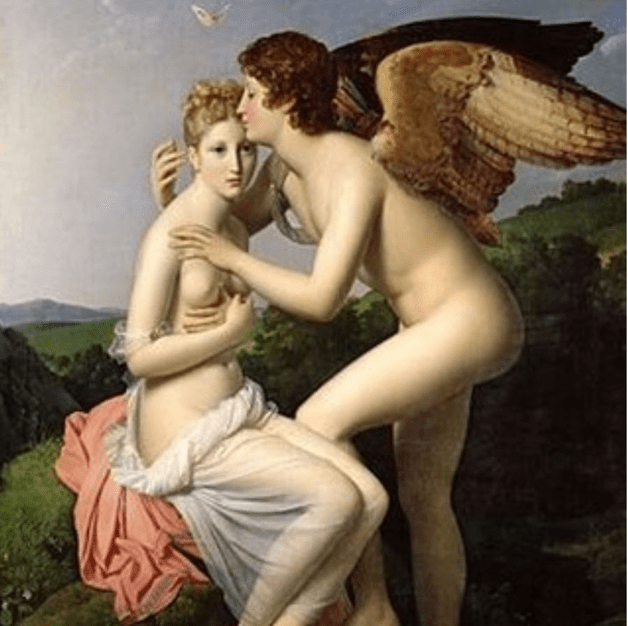
Take, for example, this image — her very first Instagram post — which took me hours upon hours to scroll back to, with many failed attempts along the way.
It was the neoclassical painting Cupid and Psyche (1798). After searching through thousands of posts, finding it felt like uncovering a quiet key to her entire body of work — and, perhaps, to the moral thread running through this article.
The myth shows a mortal soul (Psyche) united with a divine being (Cupid), an act of love that brings both transcendence and suffering. It mirrors the story of the Watchers in Genesis and Enoch: beings of light who crossed the boundary between the celestial and the human.
Looking back now, the placement of this image at the very start of her online portfolio feels like more than coincidence. It is as if, at some intuitive level, she knew the body of work she was about to share would begin with what we outline here — the attraction between the spiritually divine and the physical body born from creation.
Whether one interprets Emily’s art as theological archetypes, psychological projections, or encoded memories of ancient contact, they speak to something fundamental in the human experience — our awareness that we are being watched, guided, or tested by forces beyond comprehension.
The Language of Vision
One of Emily’s most striking illustrations features scientific symbols scattered across the page, yet in the upper corner she wrote two names: Gabriel and Uriel. Beside them she added brief but revealing annotations — linking Gabriel to clarity and Uriel to the O-negative blood type.
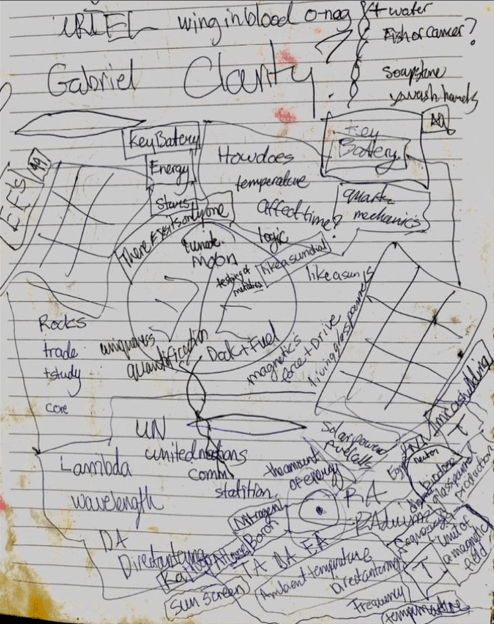
This combination of scriptural and biological imagery fascinated me. It mirrored ancient Ethiopian Christian scripture: when Christ was crucified and blood flowed from His side, the Archangel Uriel dipped his wing into that sacred blood and carried it across the Earth — sometimes said to be in a chalice, other times sprinkling it upon the land, sanctifying Ethiopia.
By invoking O-negative blood — a type often described as “universal donor” — Emily seemed to be connecting spiritual symbolism with modern genetics or perhaps this was symbolic that humans are one universal entity, that concept that to hurt another is just inflicting hurt upon yourself.
Gabriel’s association with “clarity” is equally fitting. In both canonical and apocryphal texts, he is the messenger of divine understanding, the herald who brings truth to those ready to receive it. That Emily repeatedly depicted these two figures — Gabriel and Uriel — suggests an intuitive recognition that they represent communication and illumination: the twin forces through which divine knowledge descends to humanity.
To me, these patterns in Emily’s art reveal a profound synchronicity between scripture, mythology, and contemporary experience. They connect the ancient Watchers and Archangels to the modern Phenomenon, as if the same story continues to echo through different languages of perception — from holy texts to visionary art.
Conclusion
After much reflection, I see no contradiction between the accounts in Genesis and The Book of Enoch and the possibility of an advanced extraterrestrial civilization visiting Earth in ancient times. To early humanity, such a civilization would have seemed divine — their technology, indistinguishable from miracle; their wisdom, beyond comprehension.
In cosmic terms, such missions might be the natural way for advanced species to expand — to seed and uplift intelligent life until it matures enough to join a larger interstellar community. Yet even if this interpretation holds truth, it does not diminish faith.
For me, this exploration has not weakened belief in God; it has strengthened it. I sense that both can be true: that our sacred scriptures describe real historical encounters — and that behind those encounters stands the same divine intelligence we call God.
The lesson of the Watchers remains timeless. Their failure was not simply a rebellion against authority, but a moral collapse born of pride and desire. They allowed physical and earthly desires to eclipse their spiritual purpose — and in doing so, mirrored the same conflict that continues within humanity today.
Emily Trim’s work, the spark that inspired this article, embodies that same ancient warning. The beings she and her classmates encountered at the Ariel School in 1994 delivered a consistent message: do not become too technologized.
That warning echoes across millennia, from the fall of the Watchers to our own age of artificial intelligence and genetic manipulation. The danger is not technology itself, but the imbalance between knowledge and wisdom. When technological advancement outpaces spiritual maturity, catastrophe follows — whether on the scale of a lost civilization or an entire world.
This, ultimately, is the eternal moral of Enoch’s vision and Emily’s art alike:
Do not repeat the error of the Watchers.
Do not let technology advance faster than spirit.
If humanity can remember that truth — that power without humility destroys itself — then perhaps we will finally learn what the Watchers could not: that the reconciliation between the physical and the non-physical cannot be rushed. It is a process that takes time and is easily corrupted. We must take our time, and we must pay attention to the subtle nudges we receive along the way.
Paul Coleman

 Ontological Reality